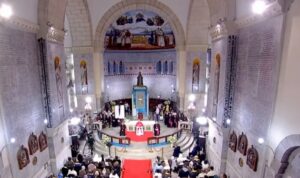


The sisters in the courtyard of Saint Charles with the statue of the Virgin Mary, Our Lady of Africa, in the middle
On September 9, 1869, eight young women from Brittany arrived in Algiers after a harrowing Mediterranean storm delayed their journey by a day. As their ship battled the tempestuous waters, Msgr. Lavigerie, Bishop of Algiers, waited anxiously and finally sent his blessing across the troubled sea, a prophetic gesture for the challenging path ahead.
We remember the 8 September as the birth date of the congregation in remembrance of the blessing Cardinal Lavigerie sent across the stormy waters and in commemoration of the birth of the Virgin Mary, our patroness.
Cardinal Lavigerie’s Vision for an African Missions
In 1869 Msgr. Charles Lavigerie, Bishop of Algiers was facing a crisis. Cholera and famine had devastated Algeria, leaving countless orphans. He envisioned a missionary congregation specifically adapted to African conditions, unlike traditional European religious orders. He sought women apostles and dispatched Father Le Mauff to Brittany, boldly but honestly promising only ‘poverty, deprivation, self-denial, and possibly martyrdom.’ Despite this austere reality, the response was remarkable: twenty-two postulants gathered in sixteen days.
The obligation to provide shelter, food and education for the children taken in during the famine necessitated agricultural work. This allowed the Sisters to respond to the immediate needs of the orphans and of the community which had no other means of livelihood.
These first sisters quickly established orphanages, schools, dispensaries, and agricultural colonies throughout Algeria and the Sahara Desert.
But this first achievement, in response to a humanitarian emergency, could not satisfy his quest or the project of his apostolic heart. He had to go further: educate, heal, open to the immensity of Africa. He envisioned a missionary congregation, destined for resilience and transformation, specifically adapted to African conditions, unlike traditional European religious orders.
Crisis and Divine Intervention
The sisters did well in craft schools, dispensaries and hospitals, visiting families and taking care of orphans. However, at the beginning of the 1880s Msgr. Lavigerie did not believe they could run their own affairs. He wanted to merge them with other existing Congregations but when those plans did not work out he decided to dissolve the Congregation and send the sisters home.
Sister Marie Salome had been elected Superior General in 1882. She was a woman who firmly believed in the young Congregation and had the qualities to lead it. Mother Marie Salome and Sister Marie Gonzague went to see the founder to convince him to let the Congregation live. Nothing doing! He seemed to have decided.
The two sisters went to pray in front of the statue of Our Lady of Africa in Notre Dame Basilica in Algiers, vowing that if Mary interceded for the continuation of the Congregation, they would place her statue in front of the Motherhouse.
The breakthrough came in 1885 when Bishop Dusserre successfully advocated with the Cardinal for their continuation and so the Congregation of the Missionary Sisters of Our Lady of Africa continued to develop and spread throughout Africa.
Sisters came from across Europe and North America, studying Bible, theology, and Arabic before deployment to African missions. They became teachers and professors, doctors and nurses, directors of schools and hospitals, lawyers and translators. They researched and preserved the culture of women’s knowledge, like weaving or traditional phytotherapy.
From Algeria, sisters first established communities in:
- Tanzania (1894)
- Congo (1895)
- Mali (1897)
- Uganda (1899)
By 1945, 1.454 sisters served in 160 communities worldwide.
Following the ideal of their founder, they in turn became promoters of 22 local congregations, to which they passed on their knowledge and skills ensuring sustainability and local leadership.
After the Second World War, with African independence and the Second Vatican Council, changes were needed, and in 1964 the headquarters was relocated from Algeria to Rome.
The Legacy Continues
Today, the Missionary Sisters of Our Lady of Africa maintain their “nomadic soul,” adapting 19th-century vision to 21st-century needs across fifteen African countries. Their story demonstrates how Catholic missions in Africa evolved in partnerships with local communities.
The statue of Our Lady of Africa, promised in prayer during their darkest hour, remains a symbol of faith rewarded and missions sustained through 150+ years of service.
Below some photos of the port of Algier in the 1880