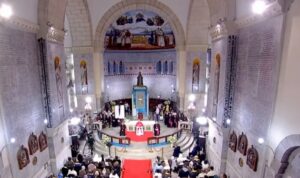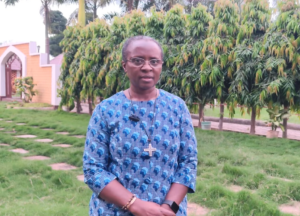


At the symposium held at Tangaza University in Nairobi on 20 September 2025 to celebrate the bicentenary of Cardinal Lavigerie, Sr Hélène Mbuyamba, MSOLA, gave a presentation highlighting the cardinal’s role in the creation of women’s congregations
Here is an abstract from the conference of Sr Hélène Mbuyamba, MSOLA
At a time when the role of women was limited to domestic and family tasks, Cardinal Lavigerie made clear that for him the apostolate of women was an indispensable complement to the apostolate of men. As a man of faith, broad-minded and endowed with extraordinary vision and foresight, he understood the importance of women’s apostolate among women and recognized their vital role in transforming society.
Even women who rarely left their homes were still at the heart of their households and it is in the home that women shape the society of tomorrow. Sisters could reach them and help them fulfill their role as educators of their children. They offered a new and liberating model of femininity, they could enter homes and meet women and girls, and take charge of their formal education.
THE VISION
In 1856, Lavigerie became the first director of the Œuvre des Ecoles d’Orient (Eastern Schools Mission). Four years later, this appointment took him to Syria, where he organized relief committees to alleviate the suffering of Christians. It was in this region that he was struck by the extraordinary influence that missionaries, especially nuns, had on Muslims.
He wrote:
I saw thousands of men and children, both Muslim and Christian, gathered around the sisters, asking them for help in their poverty, for a remedy for their health problems. I saw them kiss their clothes with respect. I heard one of them tell me that one day, as she was walking among Muslims, she was stopped by a man of the people who said to her, with curiosity mixed with respect: ‘Sister, when you come down from heaven, are you, nuns, dressed like this?”
He saw that these nuns were respected and loved by everyone, even Muslims, in a region that had been destabilized by interreligious conflicts.
THE IMPLEMENTATION
In 1863, Lavigerie was appointed bishop of Nancy. As such, he undertook to raise the level of education of the priests and sisters of the diocese, because he was concerned about the education of girls.
It is women,” he wrote to the Supreme Pontiff, “who, as mothers, are called upon to impart instruction and religious habits. If they do not have deep feelings of faith and piety, everything around them suffers.”
In August 1864, he insisted that all novices in teaching congregations attain the same level as that of lay teachers. Episcopal diplomas would therefore be necessary to run even the humblest school in the diocese.
In addition, Bishop Lavigerie did not hesitate to bring other congregations to his diocese of Nancy. It is clear that even before founding his missionary institutes, Lavigerie was convinced of the importance of the apostolic work of religious sisters.
THE FOUNDATION OF THE MISSIONARY SISTERS OF OUR LADY OF AFRICA
In June 1869, Archbishop Lavigerie announced the founding of two institutes, one for men, the “Agricultural Brothers”, who would later merge with the White Fathers, and the other for women, the “Agricultural Sisters”, who were the origin of the Missionary Sisters of Our Lady of Africa.
Speaking of the origins of the Society of Sisters, he added:
These are the good Sisters I was referring to earlier when I said that it seemed to me that, in God’s plan, women should be the most powerful missionaries to this poor African people. It is to them that the Sisters of the Missions want to devote themselves entirely, raising their children, caring for their sick, and helping their poor.”
The Cardinal’s exhortations to his daughters underscore the importance of the task he has set for them: “For such an important and difficult work (the apostolate of Christian women among African women), perfect instruments are needed, truly apostolic souls, saints.” – “Women apostles! That is what you want to be for the Church, following the example of the holy women who followed Our Lord during his earthly life and who, after his death, spread his name through their faith, charity, and example.” (Thoughts of Cardinal Lavigerie, 107-108)
There were many difficulties along the way in realizing this foundation project but thanks to the firm determination of Mother Marie Salomé and the intervention of the Missionaries of Africa, the congregation persisted and in 1886, Lavigerie said:
I have devoted the most active years of my life to laying the foundation of our Society of Missionaries. I wish to devote my old age, as long as God grants me life, to promoting what I believe to be even more important for the peoples of our Africa: the apostolate of the Sisters.”
A few days before his death, he received in audience the Superior General, Mother Marie Salomé, accompanied by Mother Hippolyte, who came to offer him the wishes of the Congregation on the occasion of Saint Charles’ Day, celebrated on November 4.
Discussing various topics with them, he offered these encouraging and hopeful words:
Do not fear for your congregation; it will live on. You are recruiting well now. It is my consolation to think that my missionary works, those of the Fathers and yours, will live on…”
As we celebrate the bicentenary of our founder, hearing these words again warms our hearts and resolutely rekindles the flame of hope for a passionate and renewed commitment to the African peoples. Since their foundation to this day, the Missionary Sisters of Our Lady of Africa have continued to live out Cardinal Lavigerie’s vision by serving women and children, promoting their dignity and autonomy, and offering services of evangelization, education, and care.
HEIRS OF THE VISION
The Missionary Sisters of Our Lady of Africa have been blessed with the opportunity to accompany 22 fledgling congregations until they became autonomous.
They saw this responsibility as the fulfillment of the guidance given by their founder, Cardinal Lavigerie: “Transform Africa through Africans who have become Christians and apostles”; lasting work could only be achieved by Africans, with missionaries serving merely as initiators.
At the closing ceremony in Namugongo of the 150th anniversary of the founding of the Missionaries of Africa, Fathers, Brothers, and Sisters, the Superior General of the Bannabikira of Uganda expressed herself as follows in her letter of congratulations:
We, the Bannabikira, are proud, in the name of Jesus, to be the firstborn (in Uganda) of the Missionaries of Africa and the Missionary Sisters of Our Lady of Africa. Our founder, Archbishop Henry Streicher (M.Afr.), had a great zeal for evangelization and, like Cardinal Charles Lavigerie, believed that women would be very important instruments of evangelization. That is why he listened to the Holy Spirit and founded our religious institute in 1910. He would not have done so himself without the maternal hands of Mother Mechtilde (MSOLA).
It is clear that we are an integral part of the Lavigerie family tree. We are very proud of this.”
Here is the List of our sisters’ congregations
- Sisters of St. Theresa of the Child Jesus, Tanzania
- Sisters Bannabikira, Daughters of Mary, Uganda
- Daughters of St Theresa of the Child Jesus, Banyatereza, Uganda
- Assumption Sisters of Nairobi, Kenya
- Daughters of the Redeemer, Zambia
- Sisters of the Child Jesus, Zambia
- Sisters of St. Theresa of the Child Jesus, Malawi
- Sœurs de St Joseph, Auxiliatrices de l’Eglise, R.D. Congo
- Filles de Marie, Reine des Apôtres, R.D. Congo
- Sœurs Bene-Tereziya, Burundi
- Sisters Abizeramariya, Rwanda
- Sœurs Benebikira, Rwanda
- Sisters of Mary Immaculate, Ghana
- Filles du Cœur Immaculé de Marie, Mali
- Institut-Famille des Sœurs de l’Annonciation de Bobo, Burkina Faso
- Sœurs de Notre-Dame du Lac, Burkina Faso
- Institut des Sœurs de l’Immaculée Conception de Ouagadougou, Burkina Faso
- Sisters of the Emmanuel, Kenya
- Sœurs Servantes de Jésus, R.D. Congo
- Daughters of Mary (Mabinti Wa Maria), Tanzania
- Sisters of Our Lady Queen of Africa, Tanzania
- Sisters of Our Lady Queen of Apostles of Mbeya, Tanzania
Most of the information in this presentation were taken from the book of Sister Marie-Andrée du Sacré-Cœur “History of the origin of the Congregations of the Missionary Sisters of our Lady of Africa” Saint Charles, 1946