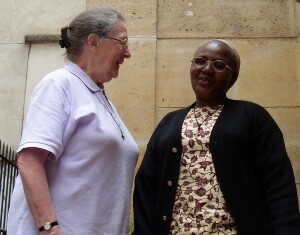
They do not let themselves be discouraged by these daily sufferings
As I was discovering how Mary personifies hope, I felt the strong link between Mary and the Congolese mamas. I understood why these mamas personify hope for me. MAMA SIFA rapidly comes down the hill. It is 6 am. She goes to Lake Kivu like every morning, with a plastic bag and … her rosary. On the shore, she fills her bag of roughly 50 kg of sand. She puts it on her back and ties it with a braided belt that encircles her forehead. With other mamas, she slowly climbs up the hill, a long calvary of a half hour, an hour or more … Whether the sun shines or the rain falls in torrents, She carries on, head bent. Mama Sifa is young. She can make three trips a day. Her rosary in hand, heart full of hope, she walks; happy to think of…
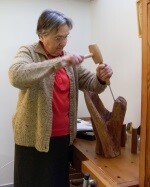
To carve is to think with the heart and speak with the hands
To carve is to think with the heart and speak with the hands. I admit that it is an exercise resulting in a lot of sweat … But this exercise shows how vital it is to go to the end of life just as the sculptor takes his time to go to the end and give life to his work. I was born in 1934 in Dordogne. In July 1956, I took my first steps in the congregation of the Missionary Sisters of Our Lady of Africa. I was sent to Africa where I had different activities. Since I am retired, I can practice the art of sculpture. In my missionary life, I was able to fulfill several services, thanks to my self-taught training;it is surely a gift from heaven, the greatest gift. Thus I was able to respond to various calls in my religious family. In Algeria, I…
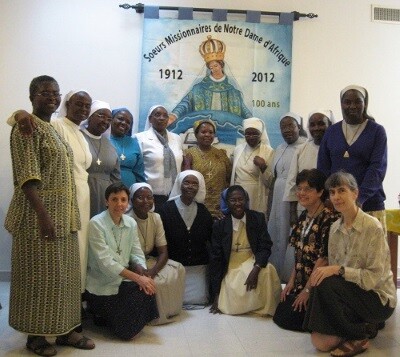
22 African Religious Congregations
The Missionary Sisters of Our Lady of Africa, participated in the founding and formation of 22 African religious congregations. The story of a great adventure ! Historical background: Feminine religious life is not new in Africa. We think for example, of the nuns of the Coptic Church. In the nineteenth century, young women entered the recently established international missionary Institutes (West Africa, Sudan). The novelty in the early twentieth century was the birth of truly indigenous active congregations. That happened as “missions” were established in the new evangelized territories. Religious life in Africa: The Missionary Sisters of Our Lady of Africa, under the leadership of their founder, Cardinal Charles Lavigerie, collaborated in the formation of 22 new congregations. The first was born in Sumbawanga (now in Tanzania) in 1903. Other foundations followed throughout the twentieth century in: Uganda, Rwanda, Congo,…

Break down all unjust structures
We join with other women in their aspirations and their struggle to be recognised in their dignity. Today women are called to unite in an effort to bring about the integral liberation of the human person and break down all unjust structures. Let us participate actively in all these efforts to make our world more human. This is also true for the Church. May it give women their rightful place; may it welcome and encourage women’s initiatives. Bishops of Uganda – 1997: “The absence of an adequate education was and still is a big obstacle to the full liberation of women. A community or a Church which ignores the educational promotion of their women will neither grow nor have a positive influence on the population, as it should have.” Mgr Mpundu – 2nd Synod for Africa – 2009: “Denial of equality to women is an affront to…
“I am proud…” 1910-2012 Burkina Faso
The Missionary Sisters of Our Lady of Africa and BURKINA FASO : 100 years of shared history, 1912-2012 ! “I am proud … Before beginning, I would like to thank God for all the benefits received in Burkina Faso and throughout Africa through this dynamic Congregation of the Missionary Sisters of Our Lady of Africa. I am moved by a feeling of joy and above all gratitude. The Lord has done great things for us, and Holy is his name. Yes, what joy for me as a Missionary Sister of Our Lady of Africa novice and a Burkinabe to live this event so important for our Congregation and for the whole Church-Family of Burkina Faso. It was really a surprise and an honor to wear the habit of the Sisters of the past and to ride a horse! I was representing one of the 8 sisters who agreed…
A storm at sea
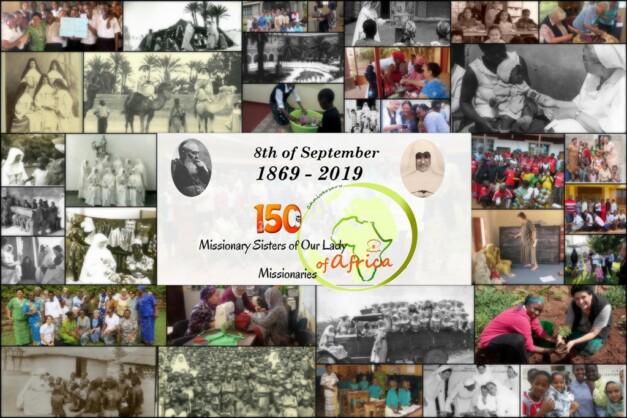
On the 9th September 1869, eight young women from Brittany in the West of France, arrived in Algiers. This was one day later than foreseen due to a very bad storm while they were crossing the Mediterranean. And thus begins the history of the Missionary Sisters of Our Lady of Africa! Msgr. Lavigerie, bishop of Algiers, had been waiting for them. Not seeing their arrival, from a high hill in the city he sent his blessing on the troubled sea and on the troubled beginnings of the future congregation. From the time of his arrival at the Episcopate in Algiers in 1866, cholera was raging in the country. There were many victims both from the famine and the illnesses that followed, leaving many orphans. To answer these needs Msgr. Lavigerie wanted to found a Congregation of sisters. But where to find religious missionary vocations? He sent to France Father…
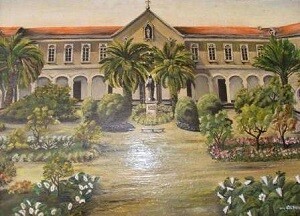
Saint Charles, our Mother House
“But where is your Mother House?” Some people ask us. A “Mother House” is normally where a religious congregation was born and where we joyfully return for various reasons (religious professions, general chapters …) It is well known, the Missionary Sisters of Our Lady of Africa have a nomadic soul!!! Our Mother House is no exception to the rule, as it has undergone many transformations and relocations following the vicissitudes of history! Our Congregation was born in Algiers in 1869 at the initiative of Msgr. Charles Lavigerie. At the time of his arrival there, a famine plagued the country. He appealed to all people of goodwill on the spot and abroad, to accommodate the many orphans. Where to lodge all these people? First it was in a local district of Ben Aknoun. Then Msgr. Lavigerie acquired a large estate in Kouba. The 300 orphans settled in the house…
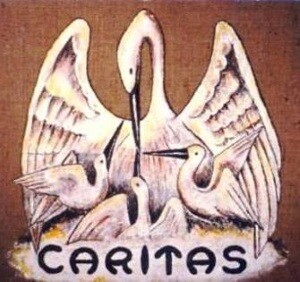
“Caritas” and the Pelican
Lavigerie, an apostle of charity :On becoming bishop, Father Lavigerie took the motto “Caritas” and as his episcopal coat of arms, a pelican – this bird which feeds its young with its own blood! His life illustrated the motto and coat of arms he had chosen. Arriving in Algiers, he addressed the Muslim Algerians: “I claim the privilege of loving you like sons …” At the bishop’s house he welcomed orphans and he founded two missionary societies to help them – the Missionaries of Africa (White Fathers) and the Missionary Sisters of Our Lady of Africa (White Sisters). He required their members the same compassion that he himself had towards the Africans. For our love to bear fruit, we must see Our Lord Himself in the patients we care for and in those touched by our charity and our patience.” Is that what…