Consecrated life, a gift from the Trinity
When I look at consecrated life, the first image that comes to me is that of a GIFT that the Trinity gives the world. This gift is updated at every period of history, according to the context, culture, events … What changes is the “wrapping,” but on the “inside” it is always God’s unconditional and merciful plan of love for us all. “In calling you, God says, ‘You are important to me, I love you, I count on you.’ This is what Jesus says to each one of us! That’s where joy is born!–the joy of that moment when Jesus looked at me. To understand and feel this, is the secret of our joy. To feel loved by God, to feel that for God we are not numbers but individuals; and to feel that it is God who calls us.” (Pope Francis) Jesus’ words come spontaneously to mind: “It is…
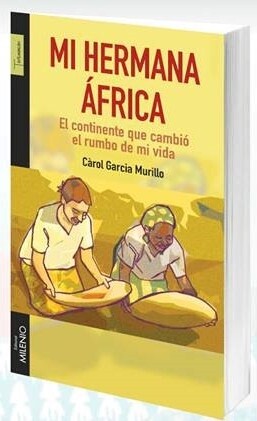
“Mi Hermana Àfrica” of Càrol Garcia Murillo
“My sister Africa,” the continent that has changed my life. Already as a little girl Carol was smiling and fearless. And she still is! Since her childhood she dreamed of Africa. She did not know much about this continent but as migrants began arriving in her region, she felt drawn to their ways of being, their traditions … She wondered about the daily life of these people. Carol spent much time with the weakest, the poorest, the most miserable…. She shared her free time with them. Thus, fascinated by the encounter, by communication with others, she began to study in Barcelona as an audioprothesist. Having finished her studies she found an interesting job in Madrid. It was perfect. She divided her time between her profession and an important commitment in pastoral care in a working class district of the Spanish capital.…
Vows of obedience, chastity and poverty
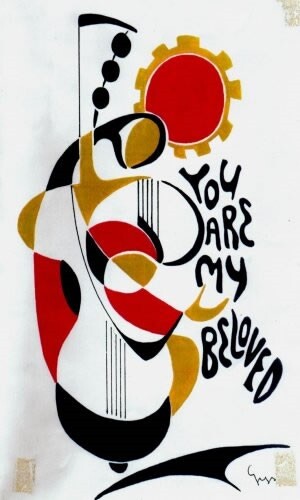
Obedience is like the “backbone” of our lives in following Christ. To obey God through human mediation can be a beautiful witness awakening the hearts of those around us. What also seems very important to us is openness to spiritual accompaniment in confidence and sincerity. In our experience of chastity, it is essential to first cultivate our personal relationship with Christ. Our life together in an international and intercultural community is a prophetic sign when we accept each other despite our differences; when we know how to accept a challenge with humility and challenge our sisters with respect. A simple smile can give life to one of my sisters or wake another one who may be isolated or locked in on herself. Creatively expressing our femininity and loyalty to community prayer is also essential to share our faith and be in communion with…
“Launch out into the deep waters”
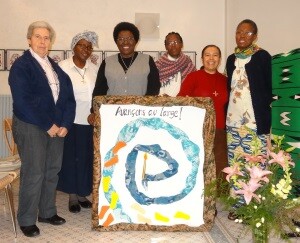
The 2016 Tertianship has begun with Gratienne from Burundi, Theopista from Uganda, Laetitia from Mexico and Julie from DRCongo. They are accompanied by Begoña from Spain and Revocata from Uganda. What is the Tertianship? The congregation invites sisters who have lived ten years of religious life after their final commitment to meet for a time of renewal and re-reading. It takes place in Rome in our generalate. Here is the biblical text chosen for the inauguration of their program: “The crowd pressed around Jesus to hear the word of God. As he stood by the lake of Galilee He saw two boats on the shore. The fishermen were washing their nets. Getting into one of the boats which was Simon’s, he asked him to depart a little from shore. Then he sat down and from the boat, he taught the multitudes. When he had finished speaking, He…
Interculturality, a prophetic sign
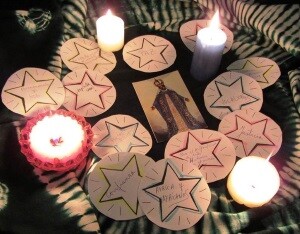
In following Christ, interculturality is possible, even if for the world it is folly. In our MSOLA family – Missionary Sisters of Our Lady of Africa- and in the individualistic, materialistic and selfish world of today, we find that interculturality is a prophetic sign. From different countries of the world and despite our differences, we share the same life. It is really a testimony. It happens for example that two sisters come from countries at war with each other but through Christ who brings us together, we live in communion and peace. What could be more prophetic? Around us people are surprised to see a European and an African living together and even more, being called “sisters.” People ask us “Where did you meet and how is it that you are sisters? It is unbelievable!” “Yes, it’s amazing, but true!” In following Christ,…

Slavery, Young women going to Europe
In “hot neighborhoods” of major European cities where prostitution is practiced, we meet very young Nigerian women, whose number is constantly increasing. Most come from Edo State in southern Nigeria. Three factors contribute to these young women being drawn into the networks of human trafficking: their desire to go to Europe to work and help their families, lack of economic means to undertake this journey and the difficulty to enter the fortress that Europe has become. Without ever meaning to, two or three days after their arrival they are found in the poorest places of prostitution: the woods, parks, along roads or in some streets of ill repute… Through meeting these young women and the persons accompanying them, I learned how they came and what makes it so difficult for them to get out of this modern slavery of which they are the victims. They sacrifice…
In the midst of the “poor”
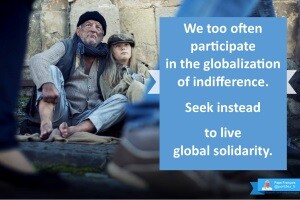
At the “Poverello” in Brussels, I find myself in the midst of the “poor” of all kinds and from all over the world. These people need to eat, but also need attention and friendship. I often have the opportunity to speak Arabic. I am very happy; I go there once a week. The Poverello is an association in the area of the North Station in Brussels. At noon we serve hot meals to needy people, street people … We serve from 100 to 150 meals a day. This takes place in a very good atmosphere. I visit people living alone, disabled or elderly who need certain services: For a year I took communion to Gaby, a former prostitute who now elderly, does not “work” anymore. She has always lived in this neighborhood. Thus I was able to dip into this milieu–a very rewarding discovery. This woman…
It is a privilege for me to be a waste for God!
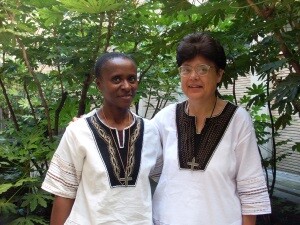
Madga : Sister Angela Kapitingana is Tanzanian. After several years of mission in Uganda, Zambia, Rwanda, Kenya, DRC, she was sent to the novitiate in Burkina Faso to work in the formation of young women who want to become Missionary Sisters of Our Lady of Africa. I asked her about her religious vocation. Magda – Sister, how did you discover your religious vocation? Angela – Discovering my vocation was not easy but in my heart I had a desire to share my faith with people who have no family especially orphans, I wanted to show that they are important in God’s eyes. Very early I lost my mother. I wanted to help my sister who did everything so that I could study. I worked hard at school until I had the opportunity to go to university. It was a decisive moment when I felt in my heart…

Afrika – Quebec
AFRIKA-QUEBEC intercultural meeting Expo: September 26 to October 16, 2015 Africa Quebec AFRIKA-QUEBEC: the story of a long-lasting friendship Women and men of Quebec, in Africa: In 1901, the Missionaries of Africa (known as the White Fathers), and in 1903, the Missionary Sisters of Our Lady of Africa (known as the White Sisters), opened their first house in Quebec City, rue des Remparts. Very soon, some young women and men of Quebec chose the missionary life and left Quebec to go to Africa. A large number have spent their whole life there, others several years. Today, we still see them serving in several African countries. Those who are back in Canada have a message for us: «In Africa, we have been warmly welcomed. We have learned the local language, the history of the country; we even danced to the rhythm of the drum. We were introduced…
Fioretti from Zambia 2
Visiting a group of ‘bansansa’ = ‘Joyous’ I ask them: ” What did you do this week?” The answers are many: – We collected firewood, drew water, cleaned around the house and they named some elderly and disabled persons. – I prevented a fight. – How did you do this, it is not easy? – I told them: Where we love … God is present, if we do not love … God is not there! They stopped! These are the words of ‘ Ubi Caritas’, which is often sung during the liturgies. Recounting this fact to a very ‘pro latin’ cousin, I asked him … “Do you think if we had sung in Latin, it would have penetrated the boy’s heart ?” The answer was a great laugh, giving me reason! “If we love one another, God abides in us …” I Jn 4, 12 ________________________________…